Skip to content

Flagship case study · 1987

281 wells. One year. 140,609 tonnes of extra oil.

The largest documented deployment of vibro-resonance technology: a full-scale programme across seven production directorates of OJSC “Nizhnevartovskneftegaz” in Western Siberia, including the Samotlor field, one of the largest oil fields ever discovered.

View the full presentation The complete 1987 report: 13 pages, including the original signed act.
281

Producing wells treated

277 returned to operation

140,609 t

Extra oil in one year

attributed to wave technology

+45%

Average rate increase

+6.7 tonnes/day per well

137

Injection wells treated

+258 m³/day average intake

A whole production association, not a pilot

In 1987 the technology was deployed across the well stock of seven oil and gas production directorates: Nizhnevartovskneft, Samotlorneft, Belozerneft, Priobneft, Chernogorneft, Novomolodezhinskneft and Ermakovneft.

The programme covered three directions at once: intensifying oil production, intensifying water injection into the formation, and improving the drilling process itself through wellbore colmatation. The results were formalised in an act approved by the Deputy Chief Executive Officer and Chief Geologist of the association.

I

Increasing oil production

Producing wells treated
281 (from the stock of 7 directorates)
Wells returned to operation
277
Wells with a measured effect
168, of which 70 still held the effect in 1988
Average production increase
+6.7 tonnes/day per well = +45% of pre-treatment rate
Total additional oil, 1987
≈ 140,609 tonnes
Full geophysical & hydrodynamic study
conducted on 7 wells under a special programme
II

Intensifying fluid injection

Injection wells treated
137, 125 returned to operation
Positive effect
on 60% of treated wells
Average intake increase
+258 m³/day per well
Average duration of effect
157 days; several wells held it into 1988
Measured formation change
higher sweep coefficient, changed injectivity profile, with previously disconnected interlayers reconnected
III

Gas-lift and drilling

Gas-lift dispersants tested
30 wells at Nizhnevartovskneft directorate
Gas consumption reduction
15–20% or more, while maintaining well flow
Wells drilled with colmatators
50, preventing washing-fluid absorption in low-pressure formations
Effect on drilling quality
better subsequent cementing; lower risk of overpull and stuck drilling tools

What changed inside the formation

Spectral gamma-gamma logging, injectivity profiles and pressure-recovery curves recorded before and after treatment: the physical evidence behind the production numbers.

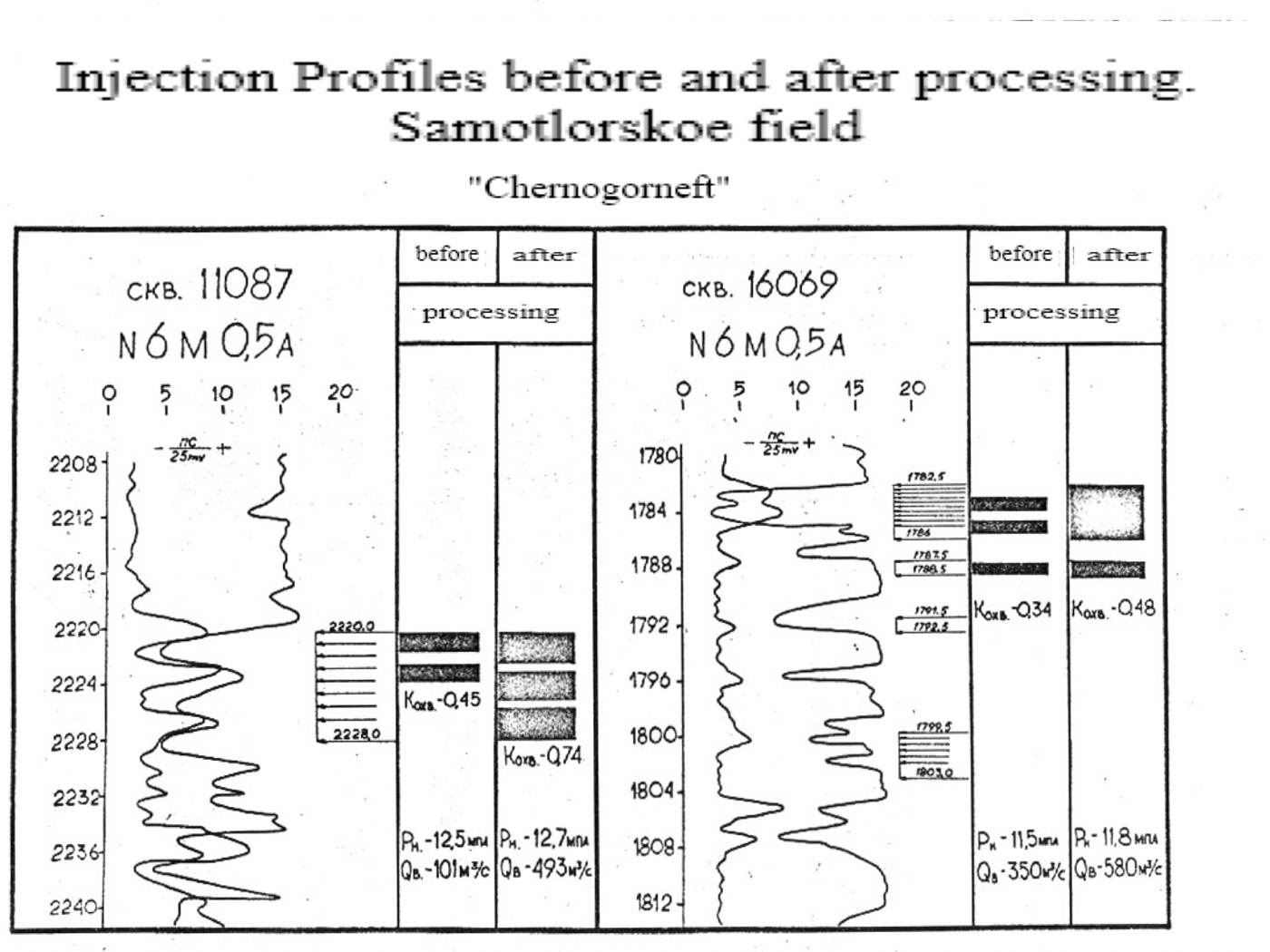
Well 11087 · Samotlor

Sweep coefficient

0.45 0.74

Water intake 101 → 493 m³/day

Well 16069 · Samotlor

Sweep coefficient

0.34 0.48

Water intake 350 → 580 m³/day

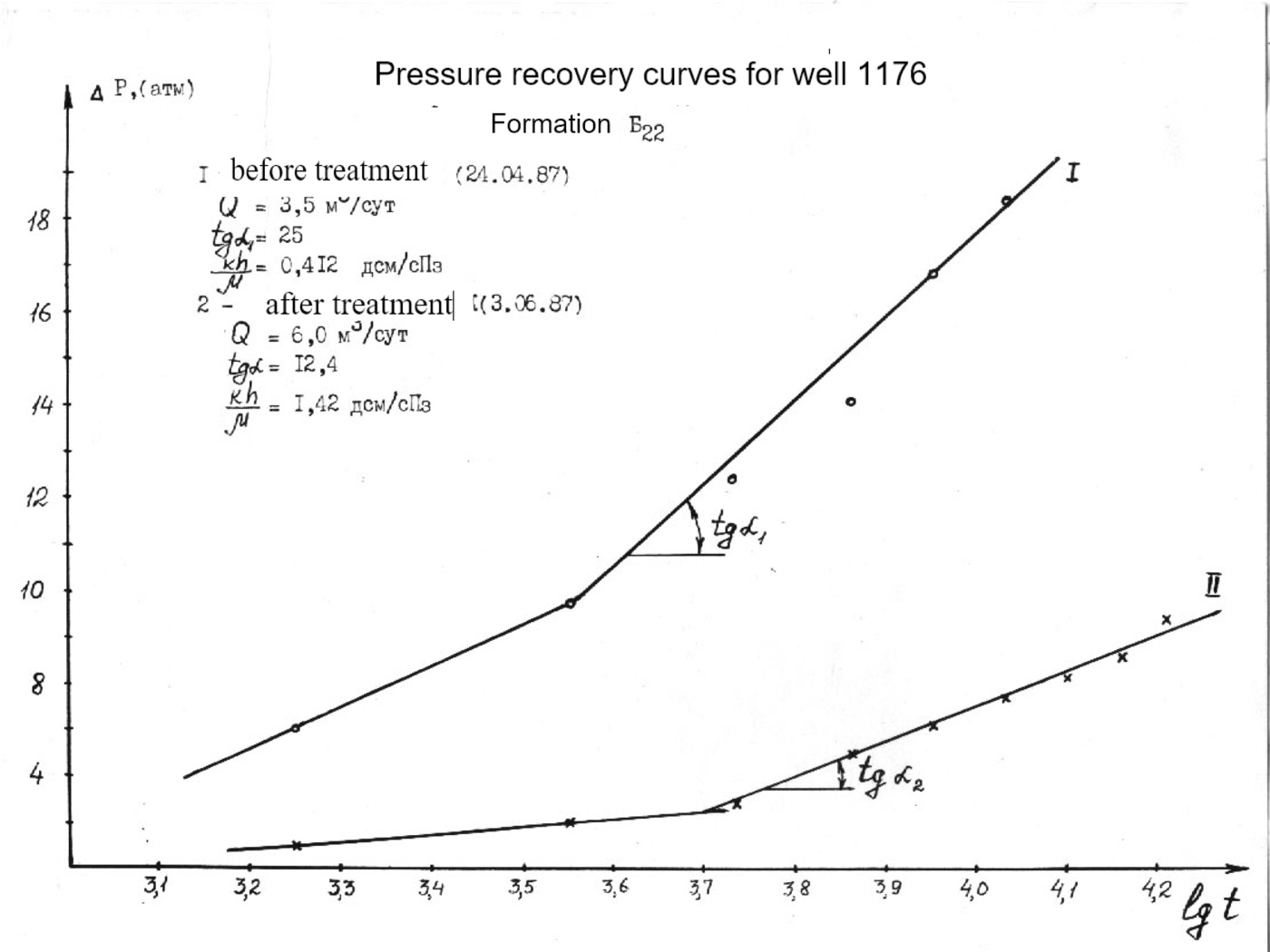
Well 1176 · formation B22

kh/μ (D·cm/cP)

0.412 1.42

Rate 3.5 → 6.0 m³/day

Well 13152 · formation AB4-5

Injectivity

1,300 1,970

m³/day

Well 25965 · Priobneft

Productivity index

0.17 0.385

m³/(day·atm) (+126%)

Well 8131 · Priobneft

Oil rate

81 95

m³/day; index 0.31 → 0.59

Injection profiles before and after treatment, Samotlorskoe field
Injection profiles before and after treatment: Samotlorskoe field, Chernogorneft.
Pressure recovery curves for well 1176 before and after treatment
Well 1176 · formation B22: kh/μ 0.412 → 1.42 D·cm/cP (≈3.4×).

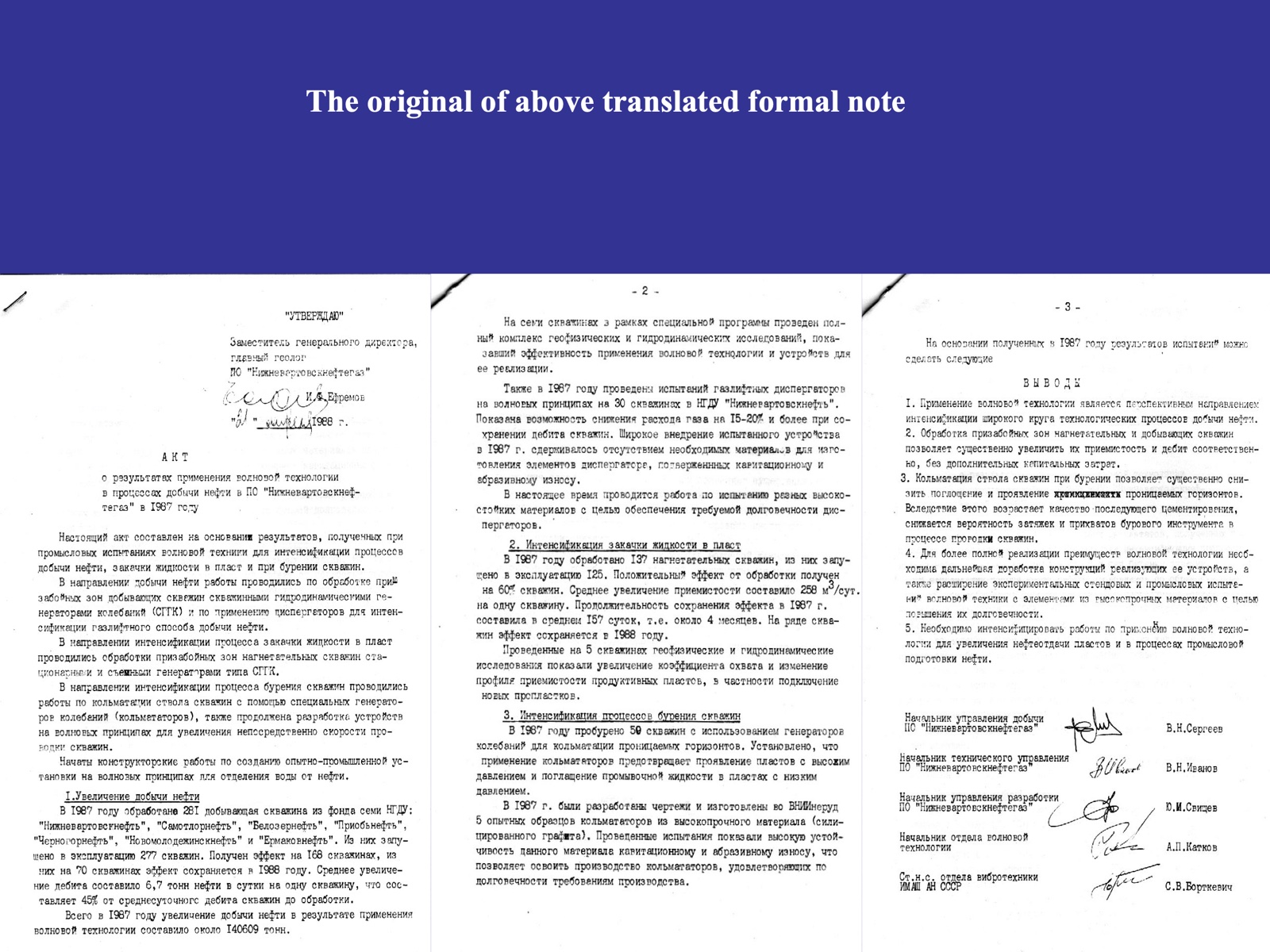
From the signed act

What the association concluded

  1. 1 The application of wave technology is a promising direction for intensifying a wide range of oil-extraction processes.
  2. 2 Treatment of the bottomhole zone of injection and producing wells significantly increases their intake and flow respectively without additional capital costs.
  3. 3 Colmatation of the wellbore during drilling significantly reduces absorption in permeable horizons, improving cementing quality and lowering the risk of stuck tools.

Approved 21 April 1988 by I.F. Efremov, Deputy Chief Executive Officer and Chief Geologist, OJSC “Nizhnevartovskneftegaz”.

Signed by the heads of the mining, technical services, development and wave-technology departments of OJSC “Nizhnevartovskneftegaz”, together with the senior research worker of the vibration engineering department, Institute of Machines Science of the USSR Academy of Sciences.

Original 1987 act on the results of wave technology application, with signatures
The original act: Russian, three pages, signed and approved.

Flagship case study · 1987

View the full presentation

The complete 1987 report: 13 pages, including the original signed act.

Download PDF
Download PDF ↗

Could your field respond the same way?

Send us the well stock data. We will assess which wells are candidates and what a programme would look like.